Fixed vs Variable Home Loans in Perth: Which Is Right for You in 2026?
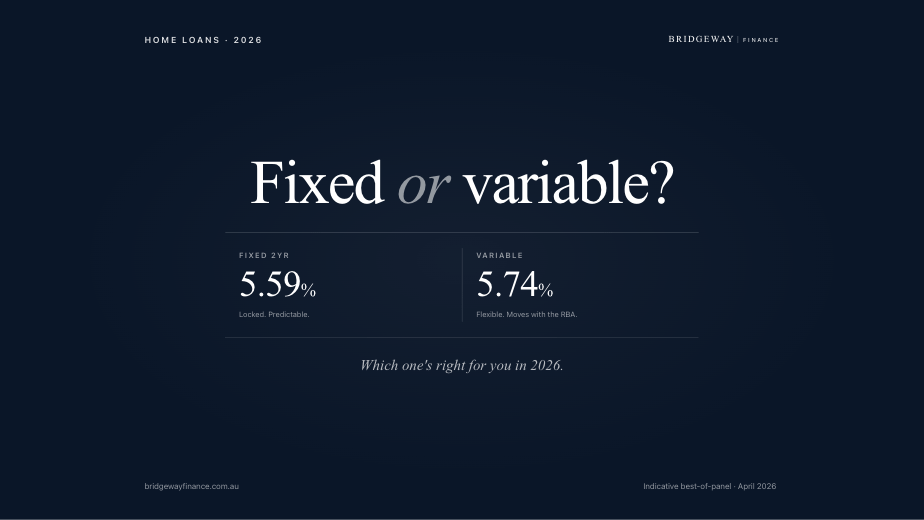
If you've ever spoken to someone about home loans, you've almost certainly been asked the question: fixed or variable?
It sounds simple. But it's actually one of the more nuanced decisions in the home loan process — and the right answer depends on your financial situation, your risk tolerance, your plans for the property, and what's happening in the broader interest rate environment at the time you're applying.
This guide cuts through the noise. We'll explain how fixed and variable rates actually work, what the real trade-offs are between the two, what split loans are and when they make sense, and how to make the decision in the context of Perth's current property and interest rate environment in 2026.
How a Variable Rate Home Loan Works
A variable rate home loan is exactly what it sounds like — the interest rate moves over time in response to changes in the market and, most significantly, changes to the Reserve Bank of Australia's official cash rate.
When the RBA raises the cash rate, lenders typically increase variable rates within a few weeks. When the RBA cuts the cash rate, lenders usually — though not always, and not always by the full amount — pass some or all of that reduction on to variable rate customers.
Variable rate loans in Australia come with a set of features that fixed rate loans often don't:
Offset accounts. An offset account is a transaction account linked to your home loan. Every dollar in the offset account reduces the loan balance on which interest is calculated. If you have a $600,000 loan and $40,000 in your offset account, you only pay interest on $560,000. Over the life of a 30-year loan, a well-used offset account can save tens of thousands of dollars in interest and shave years off your loan term.
Redraw facilities. Redraw allows you to make extra repayments into your loan and then access those extra funds later if you need them. This gives you flexibility — you can pay down your loan faster without completely losing access to those funds in an emergency.
No break costs. If you want to sell the property, refinance, or pay out the loan before a certain date, a variable rate loan lets you do so without penalty. This flexibility is significant.
Unlimited extra repayments. With most variable rate loans, you can make as many extra repayments as you like without restriction. Every extra dollar reduces your balance and therefore your interest.
The downside of variable rates is uncertainty. When rates rise — as they did significantly across 2022 and 2023 — variable rate borrowers feel every increase immediately. For someone on a tight budget, a series of rate rises can create genuine financial pressure.
How a Fixed Rate Home Loan Works
A fixed rate home loan locks your interest rate for a specified period — typically one, two, three, or five years. During that fixed period, your rate stays the same regardless of what the RBA does or what lenders do with their variable rates.
The primary appeal is certainty. You know exactly what your repayments will be for the fixed period, which makes budgeting straightforward. If rates rise during your fixed period, you're protected. If you fixed at 5.5% and variable rates move to 7%, you're paying significantly less than variable rate borrowers.
The trade-off is inflexibility:
Break costs. If you want to exit a fixed rate loan before the term ends — to sell the property, refinance, or pay it out — the lender will charge a break cost. These are calculated based on the difference between your fixed rate and the current wholesale rate, multiplied by the remaining loan balance and term. In some cases break costs can be tens of thousands of dollars. This is the most significant risk of fixing.
Limited extra repayments. Most fixed rate loans restrict the amount of extra repayments you can make — typically $10,000 per year above your minimum repayments. Making large lump sum repayments into a fixed loan can trigger break costs.
No offset account. Most fixed rate loans don't offer a fully functional offset account. Some offer a partial offset, but the full interest-saving benefit of an offset account is generally only available on variable rate loans.
Rate reversion risk. When your fixed period ends, your loan automatically reverts to the lender's standard variable rate — which may be higher than the current competitive variable rate. If you don't actively refinance or renegotiate at the end of your fixed term, you could end up paying a rate well above the market. This is the loyalty tax discussed in our refinancing guide, and fixed rate borrowers are particularly exposed to it at reversion.
The Rate Environment in 2026 — What It Means for Your Decision
Understanding the current interest rate environment is essential context for this decision. Rates moved dramatically in Australia between 2022 and 2024 — the RBA raised the cash rate from 0.1% to 4.35% in one of the fastest tightening cycles in its history, pushing variable rates to their highest levels in over a decade.
As we move through 2026, the rate environment has shifted. The RBA began cutting rates in early 2025, and the market expectation at the time of writing is for further gradual reductions over the coming 12 to 24 months. This matters because it affects the relative attractiveness of fixing.
When rates are expected to fall, fixing locks you into a rate that may soon be above the variable rate — meaning you'd be paying more than variable rate borrowers and losing the flexibility of a variable loan. In a falling rate environment, variable rates are generally more attractive because you benefit from each cut automatically.
When rates are expected to rise — as they were in 2022 — fixing provides protection against increasing repayments. In a rising rate environment, locking in a fixed rate before increases take effect can save significant money.
The fixed rates currently offered by lenders already price in market expectations about where rates are heading. This means you can't simply fix to "beat the market" — lenders price their fixed rates to reflect the expected path of rates. What fixing gives you is not necessarily a lower rate but certainty — the knowledge that your repayments won't change during the fixed period, regardless of what happens.
Fixed vs Variable — The Core Trade-Off
Strip away all the complexity, and the decision comes down to this:
Variable rate: lower flexibility cost, benefits from rate cuts, offset account available, no break costs, ideal if you may sell or refinance within the fixed period or if rates are expected to fall.
Fixed rate: repayment certainty, protection from rate rises, no flexibility to exit without break costs, limited extra repayments, no offset account, ideal if your budget is tight and certainty of repayment is worth more to you than flexibility.
Neither is universally better. The right choice depends entirely on your circumstances.
Split Loans — The Best of Both Worlds?
Many Perth borrowers choose a split loan — fixing a portion of their loan while leaving the remainder on a variable rate. This is more sensible than it might initially sound.
A common split is 50/50, but it can be any proportion. For example, on a $700,000 loan, you might fix $400,000 for two years and leave $300,000 on variable. The fixed portion gives you certainty on the majority of your repayments. The variable portion gives you access to an offset account, the ability to make extra repayments, and flexibility if your circumstances change.
The split approach acknowledges something important: nobody knows with certainty where rates are going. Splitting hedges your bet — you get partial protection against rate rises and partial benefit from rate cuts.
For borrowers who want certainty but also want to maintain some flexibility, a split loan is often the most practical solution.
Questions to Ask Yourself Before Deciding
Before you choose between fixed and variable, work through these questions honestly.
How tight is your budget? If a rate rise of 0.5% to 1% would genuinely stretch your finances, the certainty of a fixed rate may be worth the trade-offs. If you have comfortable financial buffers and your repayments are well within your means, the flexibility of variable is likely more valuable.
How long do you plan to stay in the property? If there's any reasonable chance you'll sell within two or three years, fixing is risky. Break costs on a fixed loan when you sell can be painful. Variable loans have no exit penalty.
Are you planning any large lump sum repayments? An inheritance, a bonus, proceeds from selling another asset — if you're expecting a significant sum that you'd want to put into your loan, a fixed rate will restrict this. Variable gives you complete freedom.
How important is having an offset account? If you have significant savings that you want working against your loan balance through an offset account, a variable rate loan is almost always the right choice. The interest saving from a well-funded offset account can dwarf any rate advantage from fixing.
What does your broker think? This is a question with a genuinely correct answer that depends on your specific numbers. A broker can model the expected cost of fixed versus variable under different rate scenarios, using your actual loan amount and financial position. This takes the guesswork out of the decision.
Common Mistakes When Choosing Between Fixed and Variable
Fixing purely to "beat the market." The fixed rates banks offer already price in rate expectations. You're not getting a deal by fixing — you're paying for certainty. If certainty isn't what you need, you may be giving up valuable flexibility for nothing.
Fixing for the maximum term without thinking about exit. A five-year fixed rate sounds appealing when rates are rising — but a lot can change in five years. Property values shift, income changes, family circumstances evolve. Five years of break cost exposure is a long time.
Forgetting about the reversion rate. The fixed rate period ends. What happens then is just as important as the fixed rate itself. A low two-year fixed rate that reverts to a high standard variable can cost more over three years than a slightly higher variable rate with an offset account from day one.
Not considering a split. Most borrowers think of this as a binary choice. It doesn't have to be. For many Perth borrowers, a split loan is the most sensible approach — particularly if you want some certainty without giving up your offset account entirely.
The Decision in Practice
Here's a simple framework for most Perth borrowers in 2026.
If you have strong financial buffers, plan to stay in the property long-term, have significant savings to put in an offset account, and are comfortable with some rate uncertainty — a variable rate loan is likely your best option. You benefit from rate cuts, your offset works hard for you, and you retain full flexibility.
If your budget is tighter, certainty of repayments matters more to you than flexibility, you don't have large savings to put in an offset account, and you don't anticipate selling or refinancing within the fixed period — a fixed rate gives you the predictability you need. Consider fixing for one to two years rather than three to five, to limit your break cost exposure.
If you want a balance of both — fix a portion, leave a portion variable. This is the approach most experienced borrowers and brokers gravitate toward, and for good reason.
Getting the Right Advice
The fixed vs variable decision is highly personal and highly specific to your numbers. A broker who understands your financial position, your plans, and the current rate environment can model the real-world cost difference for your situation and give you a clear recommendation.
This is exactly what Bridgeway Finance brokers do. We match Perth borrowers with licensed mortgage specialists who will work through this decision with you — not in generic terms, but using your actual loan amount, your buffer position, and your plans for the property.
Submit one form. We'll call within 24 hours to understand your situation. No cost, no obligation — just a clear, specific recommendation from the right broker for you.
Know more before you borrow


.svg)